Marriage is an agreement between two people to support and be with each other during good times as well as bad; sharing their joys and sorrows. One of the first financial decisions a couple makes together is creating a joint account. Over a period of time, they might even begin investing together, but what about health insurance? Most of us tend to assume that.. (to read the entire article visit aditya birla health blog - click here)
Wednesday, April 26, 2017
5 reasons to buy health insurance post marriage
Marriage is an agreement between two people to support and be with each other during good times as well as bad; sharing their joys and sorrows. One of the first financial decisions a couple makes together is creating a joint account. Over a period of time, they might even begin investing together, but what about health insurance? Most of us tend to assume that.. (to read the entire article visit aditya birla health blog - click here)

Monday, April 24, 2017
5 Reasons why you shouldn’t rely on just your corporate health insurance
Unforeseen circumstances are just that, ‘unforeseen’. There’s no way to know what is coming, especially when it comes to health or wellbeing, but there’s always a way to be prepared. Most of us who work for an organisation feel secure in the knowledge that our corporate health insurance scheme creates a protective shield for us and ...read more here.
Monday, April 10, 2017
8 easy ways to destroy wealth

(Image source: https://goo.gl/gvN4sv)
I usually write about creating wealth. A humid Monday night deserves a post on wealth destruction.
Here are 10 simple ways to destroy wealth:
Taking an education loan: Planning to pursue MBA from that top ranked Indian B School which promises lucrative placements? Let not the tuition fees of Rs 20 lakhs hinder your plans. Go ahead and get that education loan which the friendly neighbourhood public sector bank is offering. Check this calculator out through which you can easily calculate your education loan EMI. At an interest rate of 10.25% and a repayment period of 7 years your EMI is Rs 33,461. Assuming your starting salary is Rs 1,00,000 per month and taking into account other expenses it would be interesting to note how much you can actually end up saving of investing. The worst part of an education loan is that you cannot pursue a break or any dream of starting up unless you pay that amount off completely. And it becomes worse if the economy suddenly takes a downturn as you are stuck with either a job that doesn't pay well or you may not have a job at all!
Taking a housing loan: Had written about how it is better to rent a house rather than to buy one. There is also a popular joke:

Taking a housing and education loan destroy the opportunities you would have taken otherwise to create wealth rather than destroying wealth itself.
Timeshare: Timeshare is supposed to offer you benefits of spending holidays in the future at today' cost. One has to pay an upfront fee which in the case of a popular Indian company varies from Rs 2.5 lakhs to about Rs 17 lakhs. Apart from this one also needs to pay a maintenance fee every year. This fee can begin at Rs 17,000 every year and can go up. Timeshare forces one to take a holiday every year to get the best ROI and also does not account for other expenses like food and travel.
Let us do the maths -
Buying timeshare holiday ->
Cost of Timeshare holiday will be Rs 3 lakhs + Rs 17,000 (During Year 1) +Rs 17510 (During Year 2)+....+ Rs 34558 (During Year 25) [Considering inflation of 3%] = Rs 9,19,807
Have not even added the other costs such as for travel, food and the cost of losing freedom to holiday elsewhere because your money is locked here.
Starting SIP ->
Assuming just the maintainence fee of Rs 17,000 is divided by 12, we get Rs 1416.
Starting an SIP with this amount and increasing it by 3% every year, we invest close to Rs 6,20,000 over 25 years.
A conservative return of just 14% can offer us a corpus of Rs 56.3 lakhs.
All this with the freedom of holidaying whenevr and wherever one wants.
Money back life insurance plan: This is the best way to destroy wealth. Purchase an endowment plan which, in any case, offers highly insufficient insurance coverage. Keep paying a huge amount as premium every year. Deal with the paltry yearly returns which are offered as scraps.
Not buying health insurance because your company offers it: Will you be covered when you are in your notice period? What if you suffer an accident then? Neither can you use your existing employer's health policy nor your future employer's policy. Some times the coverage might not be enough or certain aspects of the policy might have changed without you being intimated.
Not talking to children about money: This is one of the most popular ways of destroying wealth. Warren Buffet bought his first share at the age of 11. Business communities in India educate and expose young members in their families to the world of personal finance due to which they end up being financially savvy and literate as they grow older. This helps them preserve wealth over generations. The most important factor for creating wealth is time. The sooner children are taught about money and how it works, the better it is for their well being as adults. However in India discussing money with parents is almost as taboo as sex.
Trading without knowledge: Wish to make a quick buck on a hot tip? Does getting rich fast through trading in futures and options tempt you?
Your first few bets were profitable and you feel you have mastered the art of trading?
Check out the Dunning Kruger Effect:
There is nothing worse than your first few bets being successful while trading especially if you are doing it only by instinct. The moment the tide changes you may lose everything that you have.
You don't automate it: Haven't automated your SIPs yet? This is a sure shot way to spoil the returns that can be offered by long term investing through systematic investment plans. One may forget or just be lazy to deposit the cheque. Setting up a auto debit SIP mandate ensures discipline as well as consistency.
Tuesday, March 28, 2017
4 alternative tax saving instruments
Benjamin Franklin had once quoted that there are only two certainties in life:


It would be both morbid and unrelated to write about 4 types of death.

So let us stick to writing about 4 types of tax saving instruments for you to consider:
ELSS:
ELSS stands for Equity Linked Savings Scheme
This is presently the best tax saving instrument in India
The benefits of ELSS are:
ULIP:
Due to mis-selling ULIPs have ended up getting a bad name. There are many who do not even wish to explore this instrument. Earlier there was no cap on fees and other management charges. Since commissions that were offered on selling ULIPs were very high they were often mis-sold.
ULIPs are best used for milestone centric planning. They have a lock-in period of 5 years. After the lockin period is lapsed, one can make partial withdrawals not exceeding 20% of the fund value of the policy.
The benefits of ULIPs are:
Sukanya Samriddhi Scheme:
This not only encourages the growth and progress of girl children but also helps in financial planning. This is nothing but a small savings scheme. Historically the girl child has been perceived as a burden in Indian society. The Sukanya Samriddhi Scheme has been created to assist in the destruction of this heinous belief.
The benefits of Sukanya Samriddhi Scheme are:
Senior Citizen's Savings Scheme (SCSS):
For all you seniors out there, do not fret about the bank interest rates falling down. There is still a ray of hope! To invest in this scheme one must be atleast 60 years. There can be an exception made and the eligibility can be 55 years in case the individual has taken a VRS (Voluntary Retirement Scheme). VRS takers must open the account within a month of receiving their retirement benefits and the amount invested in this scheme cannot be more than one's retirement corpus.
The benefits of Senior Citizen's Savings Scheme are:
Death
&
Taxes
It would be both morbid and unrelated to write about 4 types of death.
So let us stick to writing about 4 types of tax saving instruments for you to consider:
ELSS:
ELSS stands for Equity Linked Savings Scheme
This is presently the best tax saving instrument in India
The benefits of ELSS are:
- Investing in it helps you to claim exemption of upto Rs 1.5 lakhs under section 80C
- Across a 3-5 year period, it offers better returns than a Public Provident Fund
- Over last three years the ELSS category has offered more than 15% returns (Source: http://www.moneycontrol.com/mutual-funds/performance-tracker/returns/elss.html)
- Despite a lock in period of 3 years ELSS offers higher liquidity than PPF or NSC
ULIP:
Due to mis-selling ULIPs have ended up getting a bad name. There are many who do not even wish to explore this instrument. Earlier there was no cap on fees and other management charges. Since commissions that were offered on selling ULIPs were very high they were often mis-sold.
ULIPs are best used for milestone centric planning. They have a lock-in period of 5 years. After the lockin period is lapsed, one can make partial withdrawals not exceeding 20% of the fund value of the policy.
The benefits of ULIPs are:
- Premium invested upto Rs 1.5 lakh is tax deductible under section 80C of the Income Tax Act
- It allows the policy holder to not only choose a preferred asset class but also switch between them. So initially the ULIP can be skewed towards equity and later allocation can be made towards debt
- The insurance cover that it offers.
Sukanya Samriddhi Scheme:
This not only encourages the growth and progress of girl children but also helps in financial planning. This is nothing but a small savings scheme. Historically the girl child has been perceived as a burden in Indian society. The Sukanya Samriddhi Scheme has been created to assist in the destruction of this heinous belief.
The benefits of Sukanya Samriddhi Scheme are:
- The account can be opened with a small amount -> an initial deposit of Rs 1000 is enough after which one needs to deposit in multiples of Rs 100 subject to the maximum limit of Rs 1.5 during the financial year
- The account can be transferred to anywhere in India
- This scheme is 100% tax free which means exemption will be offered during deposit, growth as well as withdrawal
- It provides the highest rate of interest among all savings schemes in India. The government sets the rate every year. For 2016-17 the interest rate is 8.6%.
Senior Citizen's Savings Scheme (SCSS):
For all you seniors out there, do not fret about the bank interest rates falling down. There is still a ray of hope! To invest in this scheme one must be atleast 60 years. There can be an exception made and the eligibility can be 55 years in case the individual has taken a VRS (Voluntary Retirement Scheme). VRS takers must open the account within a month of receiving their retirement benefits and the amount invested in this scheme cannot be more than one's retirement corpus.
The benefits of Senior Citizen's Savings Scheme are:
- Rate of interest offered is 100 basis points more than the 5 year government bond yield
- This year the rate defined has been 8.6% pa
- The interest is paid out every quarter on the first working day of April, July, October and January.
- The investment made is exempted from tax under Section 80C however the interest earned is completely taxable.
As tax season is almost coming to a close these instruments might make you evaluate your tax management for this fiscal!
Wednesday, March 22, 2017
Why saving tax should not be a factor while choosing your health insurance policy
Looking to buy health insurance? Why?
Is it because you genuinely need it? Or because you wish to save taxes? I know your answer: for both!
Continue reading here.
Wednesday, March 1, 2017
Cautious over small and mid caps?

(Source: Moneycontrol)

(Source Businessline)
Spotting a trend?
Mr Jinesh Gopani, the head of equities at Axis Mutual Fund declared in an interview to Moneycontrol that the valuations observed in midcap funds is too high for comfort.
DSP Blackrock decided to temporarily stop accepting new inflows to its pathbreaking Microcap fund from 20th Feb 2017. From April 2013 to Dec 2016 the funds size increased from Rs 307 crores to Rs 4323 crores. NAV of most small cap funds have swelled up more than 45% in the last one year.
TATA PE Fund - 50%
L&T Emerging Business - 50%
DSPBR Microcap - 48.2%
Principal Emerging Bluechip - 47.92%
Source: https://goo.gl/4U5rme
What could be the reasons?
Reason 1: High PE - BSE Midcap is trading at a price of close to 38 times earnings which is historic. Sensex is presently trading at a price of 22 times its earnings.
Reason 2: Absolute return has been 32.57% in just the last one year
Reason 3: Lack of suitable opportunities
Smallcap funds have returned close to 24% in the last 5 years. Although they are the most volatile funds in the market, over a longer term they offer impressive returns.
Does this also mean we may witness a sudden fall in the small and mid cap space?
According to Pankaj Tibrewal (Fund Manager - Equity - Kotak Mutual Fund), most small and mid cap companies depend on the domestic markets for growth. Therefore the application of GST can have a positive impact on them which could augur well for this sector.
Saurabh Mukherjea, who is known to have predicted the 2008 crisis, feels that many mid cap pharma stocks are over valued. He goes on to say that while stock prices have gone up due to more people investing in the markets, earnings are yet to catch up.
However the ones who have invested through SIPs should continue to keep investing and not be bothered if a downturn is around the corner. In fact one must look to increase investments during the downturn. Small and Midcap funds have delivered fantastic value over longer term and thanks to the ELSS scheme, one can also earn tax benefits.
During this phase, it is important to consult one's personal finance advisor to understand the appropriate way ahead.
Sunday, February 5, 2017
Schools don't teach this

17 years
This is the minimum time spent by most of us getting a formal education.
2 years of Kindergarten
10 years of School (Primary and Secondary)
2 years of junior college (11th and 12th)
3 years of Degree College
Am not even taking into account the years invested in education by engineers, lawyers, doctors, PHDs and even those who do any sort of post graduation.
The vast majority of those who invest so many years in education do it at great cost. Both in monetary and non monetary terms. Being saddled with loans the priority is to secure a job which pays a handsome amount so that the loan emi is completely covered rather than looking for a role which offers learning and fulfillment.
This problem is not faced only by Indian schools but world over. Schools in the US are struggling with education children on basic financial lessons such as even opening a bank account.
In India, there are multiple reasons why children turn out to be financially illiterate adults. Some of them are:
a) Parents themselves are unaware about basic investing and insurance concepts
b) They trust what their parents did historically. For example: Fixed deposits being a safe investment destination. However they do not take into account that fixed deposit rates have been falling and inflation will end up pummeling whatever little returns a fixed deposit will offer. And I am not even counting the impact of TDS.
c) It is taboo for a child to discuss financial matters with parents, except, in certain communities.
d) Taking up part time jobs are still frowned upon
Some of you may feel this doesn't make sense. How can little children be financially literate?
Let us look at what happens in the United Kingdom:
An organization called Personal Financial Education Group (Pfeg) organizes My Money Week.
This is what it does:
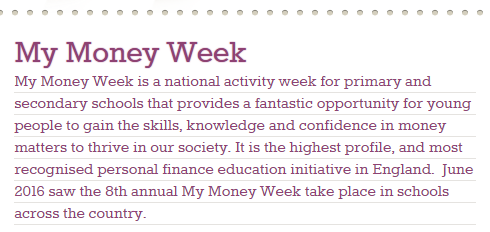
Pfeg has reached more than 2.5 million students since 2008. These students have shown a marked improvement in both financial knowledge and skills. Fashion shows, Youth Parliaments, Dramas, Debates and community economy projects have been used to educate young people.
However all is not lost for Indian students.
Interestingly in 2012, RBI came up with a draft to improve financial literacy in Indian schools: https://goo.gl/JyV7gY The list of topics covered seemed quite exhaustive and one can go through the draft in detail. Raghuram Rajan also spoke about spreading financial literacy in 2016.
Indian schools will take a few more years to warm up to the concept of spreading financial literacy and the initial baby steps will not teach children about the long term benefits of investing.
In the interim it would be great if atleast those parents who are aware about the long term value of investing encourage their children to understand the benefits of investing. A demat account can be opened in the name of a minor by its natural guardian provided the latter is atleast 18 years old.
Let us assume you create a demat account for your child by the time she is three and begin investing Rs 500 per month. By the time she is 12, she could invest this amount as children of most people reading this article would be getting a lot more than Rs 500 as pocket money by the time they are 12.
When the child is 20, she could earn:
At a CAGR of 15%, one can earn a corpus of Rs 4.7 lakhs
At a CAGR of 20%, one can earn a corpus of Rs 8.5 lakhs
At a CAGR of 25%, one can earn a corpus of Rs 16.19 lakhs
According to this article, Birla Sun Life Equity Fund has offered close to 20% returns over 15 years.
Imagine completing formal education with a corpus of Rs 16 lakhs. Not bad eh?
The standard disclaimer: Mutual funds are subject to market risk. Please read the offer document before investing
The important disclaimer: You are inviting inflation to destroy you if you dont invest in equity for the longer term.
Subscribe to:
Posts (Atom)